A recorded version of this talk was played at SciComm Collider 2026 at the Perimeter Institute for Theoretical Physics on 19 October 2026. This is the written version.
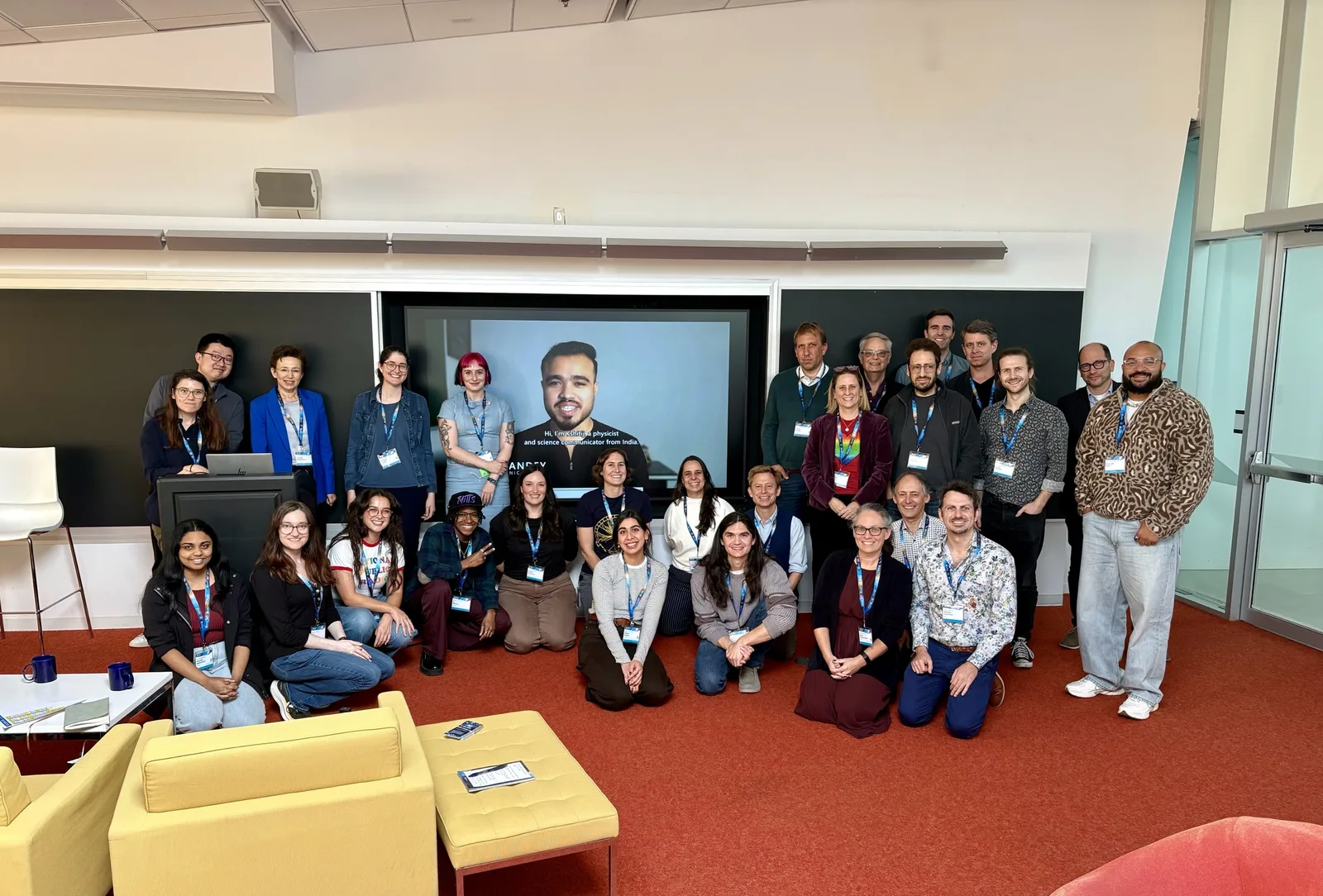
The talk playing at SciComm Collider 2026, Perimeter Institute, 19 October 2026.
In May 2024, I was running astronomy sessions in villages in Ladakh, high up in the Indian Himalayas. One of the children I met was training to become a monk. He asked me a question that I still think about.
"What did the Big Bang collide with?"
And I, very confidently, said, "Nothing collided."
He asked, "Then how did it burst?"
You can hear a picture in his questions. A bang suggests a collision. A burst suggests an explosion. He was trying to understand a new idea through something familiar, and he was doing it well.
I should have asked him what he was imagining. I didn't. Instead, I started talking about matter and antimatter, and how they annihilate when they meet, and I told him that collision was the Big Bang.
It wasn't. Matter-antimatter annihilation did happen in the early universe, but that is not what the Big Bang means. I had rejected his collision and then handed him one of my own.
A Wrong Answer That Is Easy to Picture
What troubles me isn't only that my answer was wrong. It's that it was easy to picture. And once you have a picture, you start drawing conclusions from it.
So let's try that. Suppose the Big Bang really was two things colliding. What would have to be true?
The two things would have to exist already. They'd need somewhere to meet. Suddenly the Big Bang is an event at one location, inside space that was already there.
That isn't what cosmology tells us. The picture is of an early universe that was hot and dense, and as it expanded, the distances between galaxies grew on large scales. There is no special center to that expansion, and no spot in space where it all started.
So the real test of an explanation isn't "was my sentence accurate?" It's "what could someone reasonably conclude from it?"
Two Circles, and a Catch
Why did the collision story feel so tempting to me? I think it comes back to what we share, and what we don't.
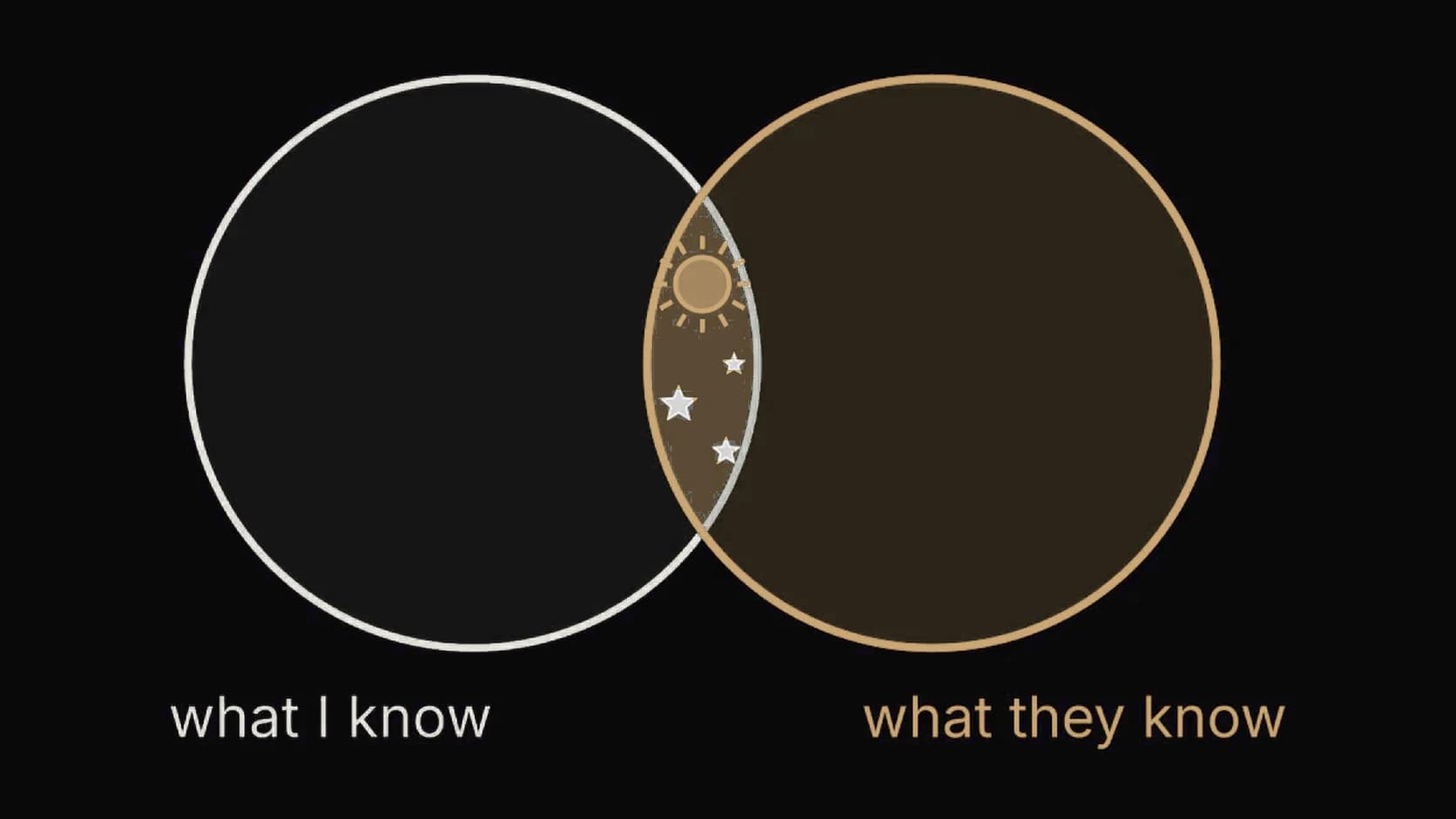
If I'm talking to another physicist about black holes, I can take a lot of concepts for granted. If I'm talking to someone who hasn't studied physics, I first need to figure out which ideas we actually share. I picture it as two overlapping circles: what I know, and what they know. The overlap in the middle is where a conversation can begin.
These circles aren't about intelligence. Someone may understand the world in ways I don't and simply not use our terminology. We might share very little formal physics, but we both know the warmth of sunlight and the night sky.
That gives us somewhere to start. But here's the catch: sharing an experience doesn't mean sharing an explanation of it. You and I could watch the same sunset and explain it completely differently. So my job is to find out what the listener thinks is happening, not to assume I already know.
There's some lovely work on this. John Clement, a physics education researcher, studied how "bridging analogies" help students reach an idea that feels wrong to them. You start from something they already accept, then move through in-between cases that let them check each link for themselves. Here is a sequence in that spirit. Picture a book on a spring. Easy: the spring squishes and pushes back. Now put the book on foam, then on a board that bends a little, and finally on a table. And here's the aha part: the table pushes up too. We just can't see it bend.
Each step lets the student test the connection instead of taking our word for it. But not every everyday analogy works. A collision is a bad bridge to cosmic expansion. It drags in all the wrong ideas: a place, a moment, two things smashing together.
What Are We Allowed to Simplify?
That also makes me wonder what we're allowed to simplify. I sometimes think of an explanation as having a soul and a body. The soul is the central idea you want to get across. The body is everything around it: the terminology, the math, the technical detail.
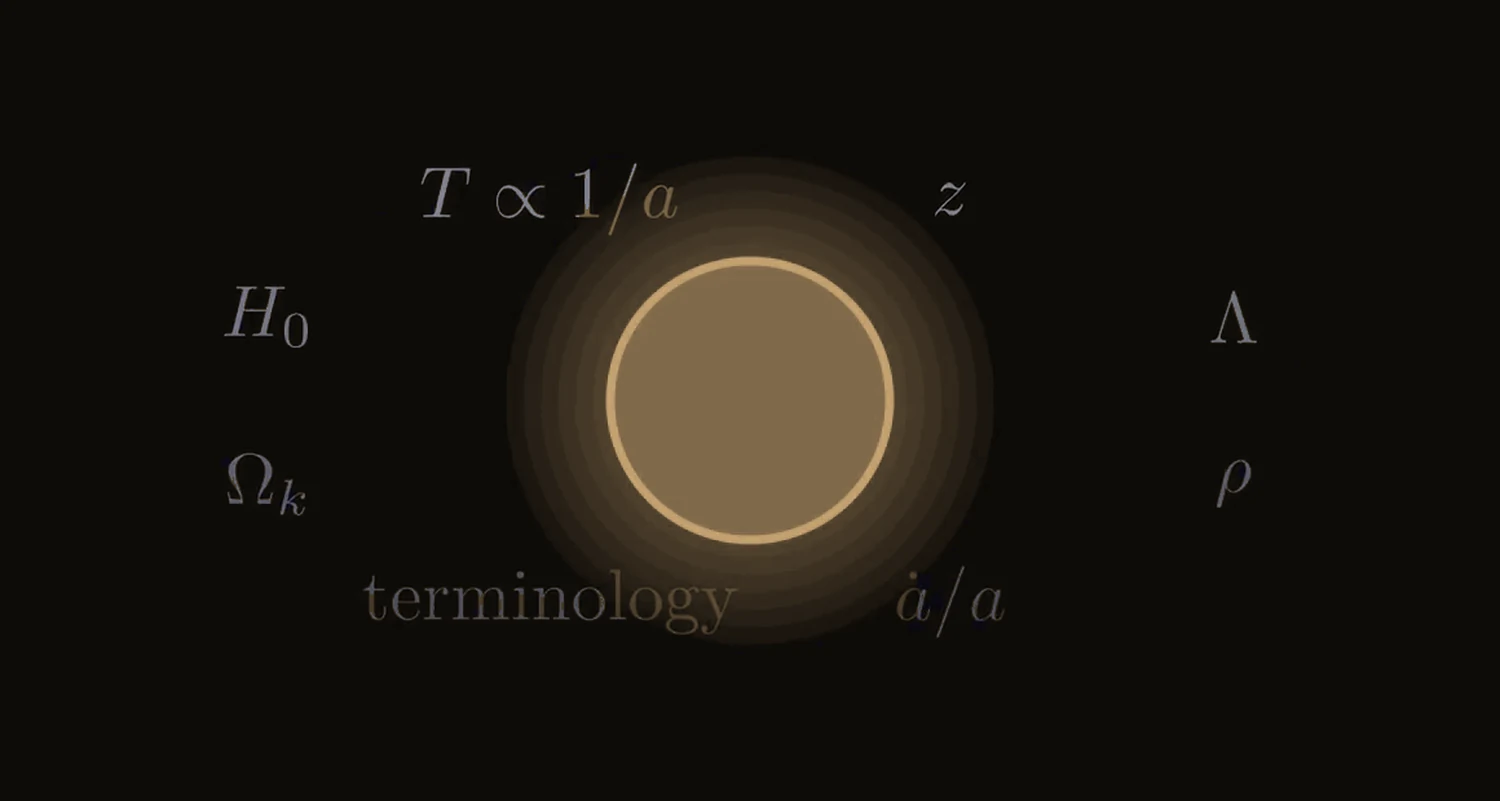
The soul is the glowing idea. The body is everything faded around it.
I have to be careful with that metaphor, though. Sometimes the math, or the mechanism, is the idea. You can't strip it away and expect the meaning to survive. So maybe the better question isn't "How much detail can I remove?" It's "What must remain true after I've removed it?"
There's even a slightly provocative name for simplified teaching models: "lies-to-children," a phrase from Jack Cohen and Ian Stewart. Nobody is trying to deceive anyone. The point is to give a beginner something they can improve on later. But that label doesn't tell us which simplifications help. Leaving out a detail for later is one thing. Inventing a mechanism that doesn't exist is something else. My collision wasn't a first step on a ladder. It was a step in the wrong direction.
When an Explanation Only Feels Successful
There's another trap, and it's sneakier: an explanation can feel successful even when very little has been understood.
In 2025, the psychologists Francisco Cruz and Tania Lombrozo published nine experiments with nearly 6,700 people. They found that jargon made explanations more satisfying while making them less comprehensible. People seemed to assume the jargon was filling in the gaps. Interestingly, when people were first asked to write an explanation of their own, they gave less inflated ratings to poor explanations full of jargon.
So everyday language can give people the wrong picture, and technical language can give them the feeling they've understood when they haven't. A nod, a smile, or an "Oh, I get it" doesn't tell us which one happened.
The Inference Audit
The question I want to ask instead is: can they use it? Can they put it in their own words, apply it to something new? And what wrong conclusions might they walk away with?
We can turn that into a habit. I call it an inference audit. Fancy name, I know. It isn't a new theory, just a practical habit built on decades of work in science education.
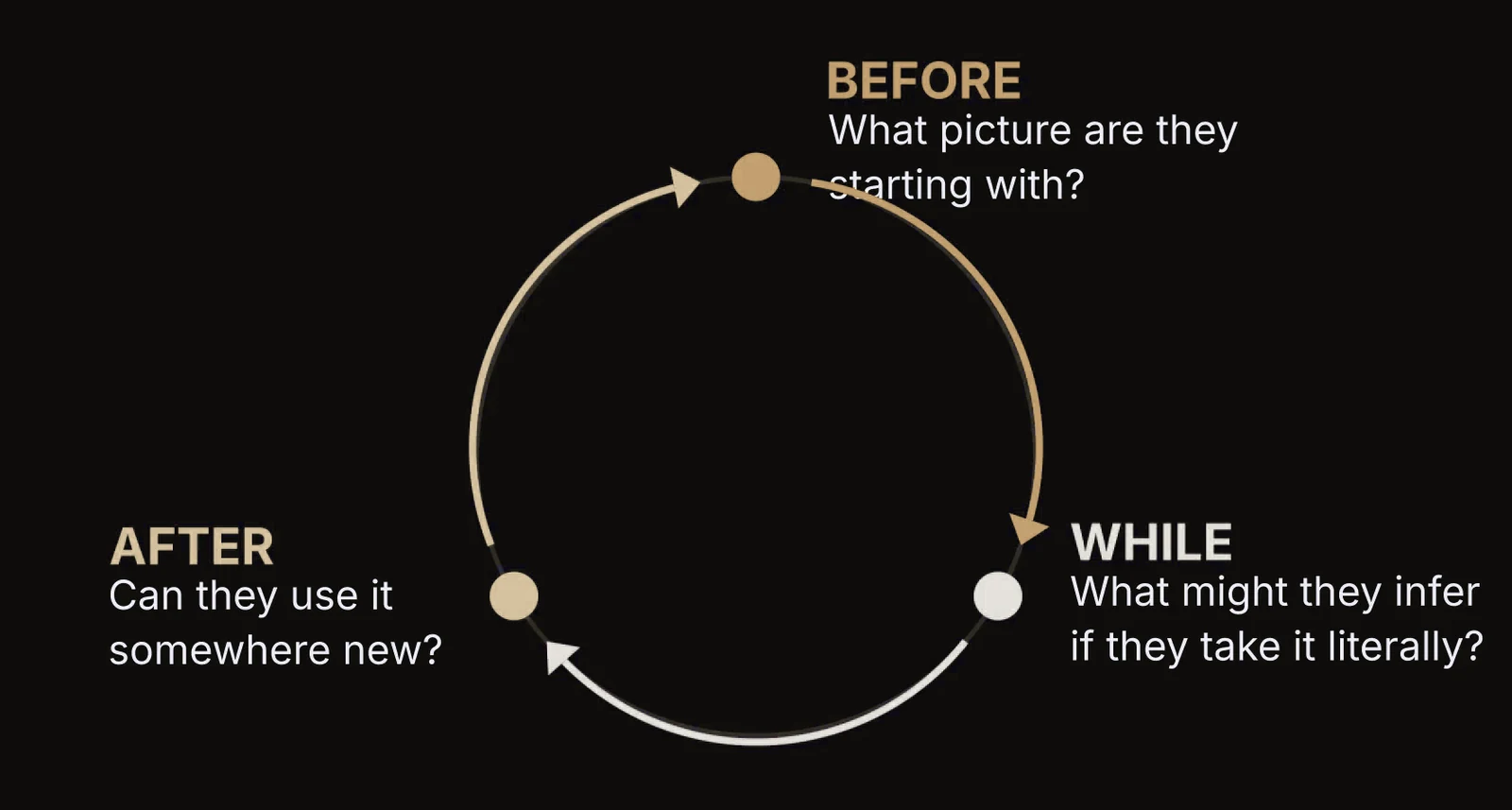
The audit is a loop, not a checklist: what you learn afterwards changes what you ask before.
| When | What to ask |
|---|---|
| Before explaining | What picture is this person starting with? |
| While explaining | What else might they infer if they take this literally? |
| Afterwards | Can they use the idea on a new question that depends on it? Listen to their reasoning. |
A lot of my work is videos in Hindi. With a video, I can't stop and ask every viewer what they're picturing. But before I publish, I can try the explanation on a few people from the audience I'm making it for. I ask what they think before they hear it. Then I ask them to apply it to something new. If the same wrong idea keeps popping up, I change the explanation and try again with new people. That's not a controlled experiment. But it catches mistakes that likes and compliments never will.
If I could go back to that first child's question, I wouldn't start with antimatter. I'd ask, "When you say it burst, what do you imagine happened?" Then I'd try a more careful answer: the Big Bang describes an early period when the universe was much hotter and denser, and as it expanded, it cooled. It wasn't two objects colliding in empty space.
Then I'd ask, "Would there need to be a center, like the center of an explosion?" His answer would show me whether the old picture was still there.
But What If They Don't Feel Free to Answer?
There's a problem with saying "just ask your audience." What if they don't feel free to answer?
Think about where we were. I was the visiting physicist. He was a child asking me a question. If he went quiet, maybe he was unsure. If he nodded, maybe he was just being polite. I couldn't assume that words familiar to me meant the same thing to him.
A clever analogy can't solve that on its own. Science communication is also about who gets to speak, whose questions change the conversation, and whether disagreement feels possible.
One example of taking language seriously is the Emory-Tibet Science Initiative. It brings modern science to Tibetan monastic students, with translators, scientists and Tibetan scholars working together on Tibetan scientific vocabulary and teaching materials, including thousands of standardised terms. They aren't just swapping words. They're making science discussable across very different intellectual and linguistic traditions.
Honestly, I don't know exactly what that child understood after our conversation. That's part of the point. I never properly checked.
Two Children, Two Questions
I remember another question from that session. A child asked, "How could anyone know what happened so long ago?"
That child wasn't asking for a simpler description of the early universe. He was asking something different: why we believe the description at all. To answer that, we could talk about light from distant galaxies, and the cosmic microwave background, which is basically the faint afterglow of the early universe, and how we test our models against what we observe. And we'd be honest about what we still don't know.
But first, I needed to notice what he was asking. One child was asking "What happened?" The other was asking "How do you know?" They need different explanations, and I won't notice the difference unless I listen.
Try This
Here's a small exercise. Think of an explanation you love giving. You probably have one, the one that almost always gets that satisfying "Oh, now I get it."
Got it? Now ask yourself: what's the most plausible wrong conclusion someone could draw from it? And what might they reveal if you asked them to use it in a new situation?
So, Where Does This Leave Us?
I began with a child who asked what the Big Bang collided with. I was so busy searching for a simple answer that I missed the most useful information I had: his question was already telling me what he was picturing.
Maybe a good science explanation isn't finished when we've made it sound simple. Maybe it gets better when we discover what our words made someone else think.
And if you have an example of your own, or you disagree with me, I'd genuinely love to hear it. You can write to me here.
Sources
- Cruz, F. and Lombrozo, T. (2025). How laypeople evaluate scientific explanations containing jargon. Nature Human Behaviour, 9(10), 2038 to 2053.
- John Clement's work on anchoring intuitions and bridging analogies, summarised in this paper from UMass Amherst.
- Samphel, T., Namgyal, D., Drongbu, D. T. and Khangsar, K. T. (2021). Translation: A Key Component of a Hundred-Year Project. Frontiers in Communication.
- Cohen, J. and Stewart, I. (1994). The Collapse of Chaos, the origin of the phrase "lies-to-children".