In short
- The paper's 16 speed divisions are correct for their printed inputs. With the right choice of units, the line lands within about 6% of the speed of light.
- But run the same line through the astronomy of the traditions it comes from, and it falls apart. Inside their own models, sunlight would reach Earth in 5 to 22 seconds instead of 8 minutes 19 seconds.
- The near-match only appears when the yojana is pinned to Earth's size. Pin it to the Sun's distance in the same texts, and the line gives 22 to 100 times the speed of light.
- The unit choices behind the match are also weakly supported, and the paper itself disclaims any ancient measurement.
I remember I was around 14, sitting in the audience at an event, when I first heard someone on stage say that the speed of light was already mentioned in our scriptures. I was fascinated. I couldn't stop talking about it with my friends and family. To think that our ancestors knew something so advanced, so long ago.
Later, when I started studying physics, I began to grow sceptical. Not of our heritage, but of claims that were repeated without anyone checking them.
Don't get me wrong. When I question an idea like this, I don't mean that ancient India had nothing to offer. I study Indian astronomy in my free time, read about the discoveries we can support with evidence, and have attended online lectures on the subject. One of my future plans is to study and explore ancient Indian astronomy more deeply and make documentaries about it.
But as a sceptic, I also want to be extra careful that claims which could be wrong or misleading don't spread in our culture's name. A claim that falls apart under scrutiny doesn't honour a tradition. It hurts its reputation.
So when a peer-reviewed paper on exactly this question came out in August 2026, I wanted to know two things. What does the ancient statement actually say? And does the claim survive a real physics test?
The paper is by Kartik Iyer, Mohit Gour and Govind Maurya, published in the Proceedings of the Indian National Science Academy. I checked its calculations, then I tested the claim against the astronomy of the same traditions it draws its units from.
What the Paper Actually Says
The statement comes from Sayana, a 14th-century scholar who wrote a famous commentary on the Rigveda. While explaining a hymn to the Sun, he quoted a traditional line: the Sun travels 2,202 yojanas in half a nimesa.
A yojana is an old unit of distance. A nimesa is a very short unit of time, often described as the blink of an eye.
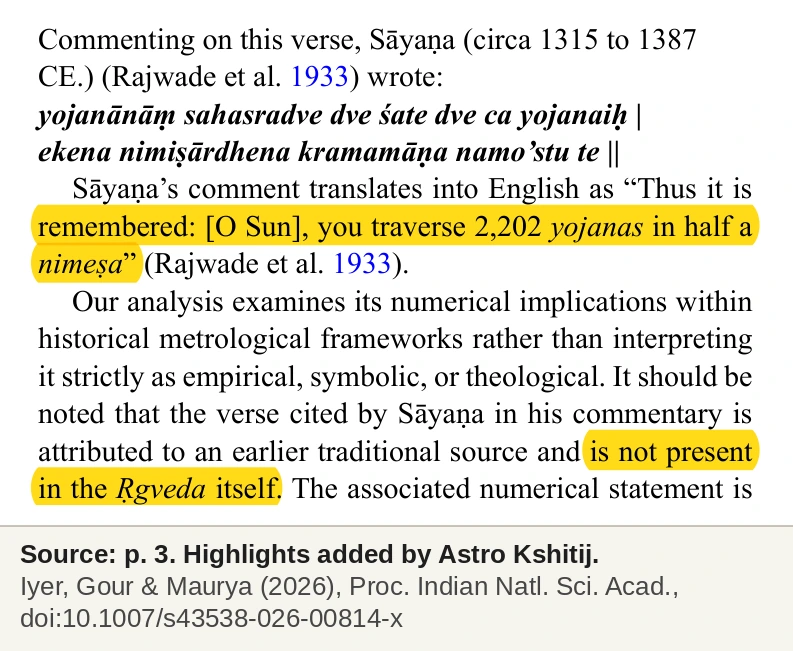
Figure 1: The line quoted in Sayana's commentary, and the paper's note that it is not part of the Rigveda itself. (Iyer, Gour & Maurya 2026, p. 3)
The paper gets one important point right. This number is not a verse of the Rigveda. It appears in Sayana's commentary, quoted as something traditionally remembered.
The authors collect different values for the yojana and the nimesa from old texts, combine them into 16 possible speeds, and compare each with the speed of light in vacuum, exactly 299,792.458 km/s.
Their final paragraph explicitly disclaims an experimentally established ancient measurement.
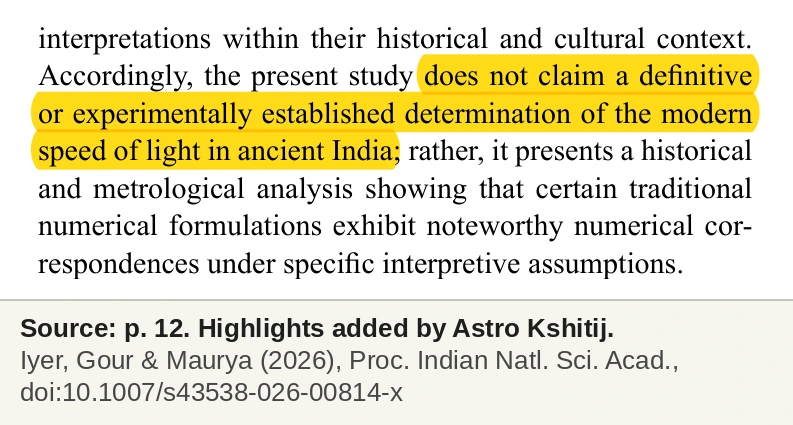
Figure 2: The paper's own limitation, in its final paragraph. (Iyer, Gour & Maurya 2026, p. 12)
But elsewhere the paper speaks more confidently. Its abstract refers to "Sāyaṇācārya's numerical value for the speed of light", and its conclusion says he "postulates" one (Figure 17). So the paper doesn't claim an ancient experiment, but it does identify this number with the speed of light. That identification is what I tested.
How the Calculation Works
"2,202 yojanas in half a nimesa" is a speed. To turn it into kilometres per second, we need two conversions:
- Y = how many kilometres are in one yojana
- N = how many seconds are in one nimesa
The distance is 2,202 × Y kilometres. The time is half a nimesa, or N ÷ 2 seconds. Speed is distance divided by time:
Speed = 2,202 × Y ÷ (N ÷ 2) = 4,404 × Y ÷ N (km/s)
The 4,404 is just 2 × 2,202. It already takes care of the "half", so you divide by the full nimesa.
So the answer depends entirely on which conversions you choose. A bigger yojana gives a bigger speed; a longer nimesa gives a smaller one.
To compare each answer with the real speed of light, the paper uses a percentage difference: how far the answer is above or below the real value, as a share of that value. +6% means 6% too high. −15% means 15% too low.
Turning a Yojana into Kilometres
For several of its astronomical values, the paper finds the length of a yojana using calibration: checking an unknown measuring scale against something whose size you already know.
Imagine you find an old ruler with markings you don't recognise. You know the table it was used to measure is 2 metres long, and the old ruler says the table is 10 units. Then each unit must be about 20 cm.
The paper does the same with Earth. Old astronomy texts give Earth's size in yojanas. Compare that with Earth's modern size, and you get kilometres per yojana:
km per yojana = modern Earth size in km ÷ historical Earth size in yojanas
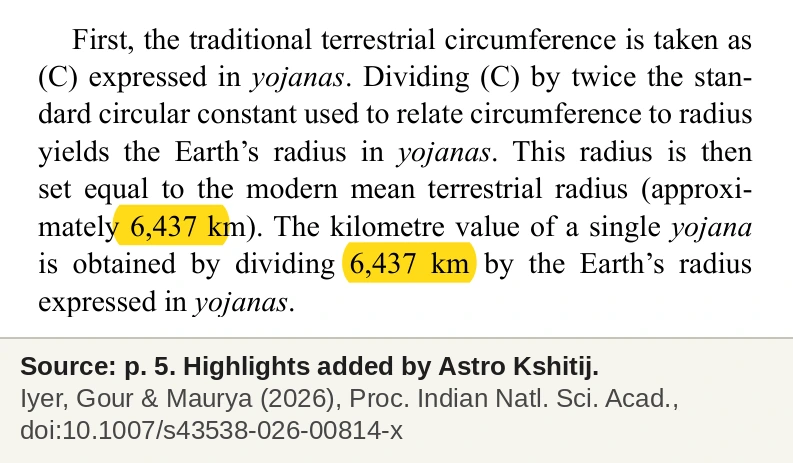
Figure 3: The calibration method. (Iyer, Gour & Maurya 2026, p. 5)
This is a reasonable starting point, but it is conditional:
- It gives the kilometre value a text's yojana would need for its stated Earth size to match the modern one. If the text's Earth size was off, that error is silently absorbed into the yojana.
- It doesn't tell us which yojana Sayana's line had in mind.
- A ruler set using Earth will, of course, get Earth right. That part is not an independent check.
Keep that last point in mind. It turns out to be the key to this whole claim.
The Arithmetic Holds Up
I recalculated all 16 speeds in the paper's Tables 3 to 5, using the printed inputs. Every one reproduces, to the displayed rounding. The full list is in the appendix.
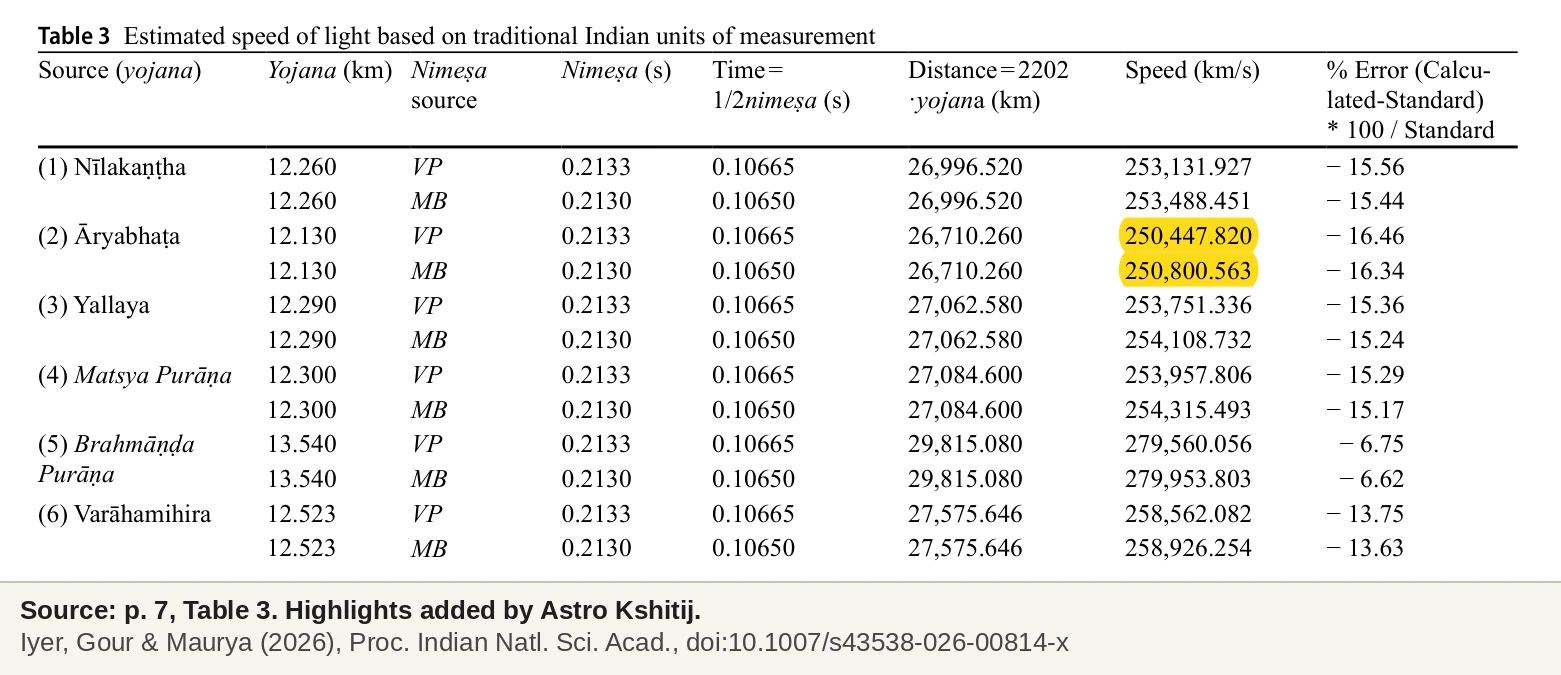
Figure 4: Twelve of the 16 tabulated speeds. (Iyer, Gour & Maurya 2026, p. 7, Table 3)
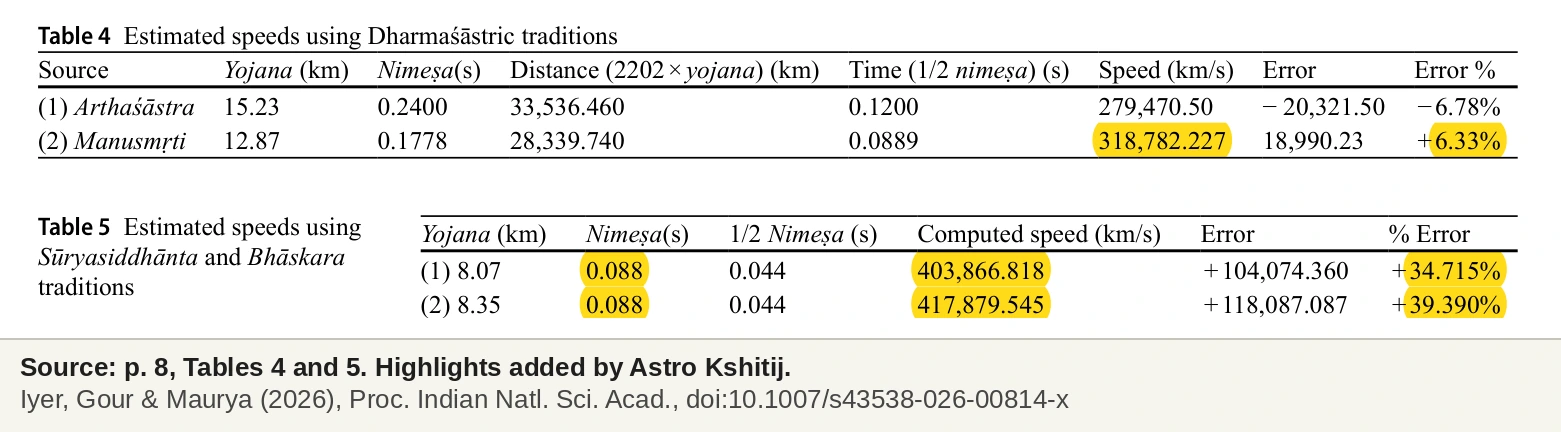
Figure 5: The other four, including the closest of the 16, the Manusmriti row. (Iyer, Gour & Maurya 2026, p. 8, Tables 4 and 5)
Among these 16 results, the closest is the row labelled Manusmriti. It uses a yojana of 12.87 km and a nimesa of 0.1778 s:
4,404 × 12.87 ÷ 0.1778 ≈ 318,782.227 km/s, about 6.334% above the modern value.
So the division is fine. But getting near the speed of light is easy when you can choose your units. The real question is whether the number survives contact with the rest of the sky.
The Physics Pressure Test
Here is the test that matters most.
The yojanas in this paper come from Indian astronomy texts. Those same texts don't just give Earth's size. They also give the distance to the Sun, in the same yojanas. So we can ask a simple question:
If 2,202 yojanas per half nimesa really is the speed of light, how long does sunlight take to reach Earth inside each tradition's own model?
The real answer is about 8 minutes 19 seconds, or 499 seconds.
And there's a neat feature. If the Sun is D yojanas away, light at 4,404 yojanas per nimesa arrives in:
Light time = (D ÷ 4,404) × N seconds
The yojana cancels out completely. So no kilometre conversion can rescue this test or sink it. Only the tradition's own Sun distance and its nimesa matter. I use only nimesa values the paper itself pairs with each tradition.
One note before the numbers. Every astronomy before the telescope, Greek astronomy included, placed the Sun far too close. This is not a criticism of ancient astronomers. It's a test of the modern claim that this line describes the speed of light.
Test 1: A control that has to pass
Aryabhata gives Earth's diameter as 1,050 yojanas. With the paper's 12.13 km yojana, Earth's equator spins at about 0.464 km/s. The real value is 0.465 km/s.
A near-perfect match, and it has to be, because the yojana was set using Earth's size and the nimesa using the length of the day. Anything built only from Earth and the day will come out right by construction. That's exactly why it proves nothing. The real test is something the calibration never touched: the Sun.
Test 2: Aryabhata's Sun
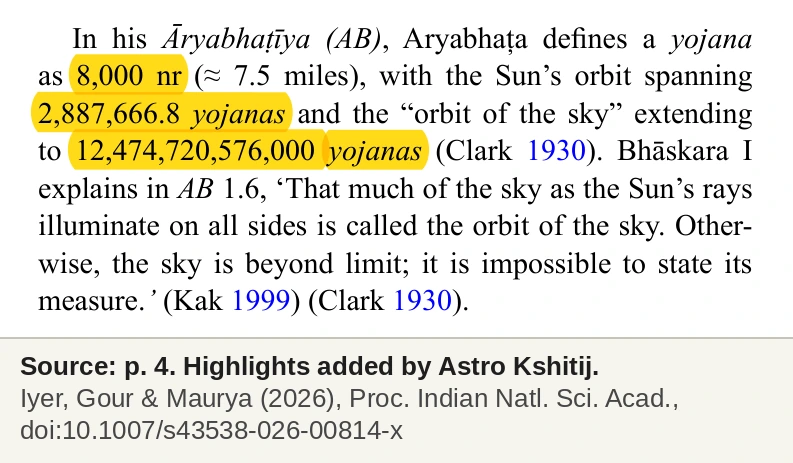
Figure 6: Aryabhata's Sun orbit, printed in the paper itself. (Iyer, Gour & Maurya 2026, p. 4)
The paper prints Aryabhata's Sun orbit: 2,887,666.8 yojanas around. That puts the Sun about 459,585 yojanas from Earth. Earth's radius is 525 yojanas, so the Sun sits about 875 Earth radii away.
The real figure is about 23,481 Earth radii. No unit conversion is needed for this comparison. Aryabhata's Sun is about 27 times too close.
Now the light time, with the paper's own nimesa for the Aryabhata rows (0.2133 s):
459,585 ÷ 4,404 × 0.2133 s = 22.3 seconds.
Inside Aryabhata's own sky, sunlight would reach Earth in 22 seconds, not 8 minutes.
The Moon is a telling contrast. Aryabhata's Moon sits about 65.5 Earth radii away, against a real 60.3. Close. The model works near Earth and breaks further out, which is exactly why a ruler set using Earth looks good.
Test 3: The Surya Siddhanta's Sun
The Surya Siddhanta gives Earth's diameter as 1,600 yojanas (verse 1.59) and the Sun's orbit as 4,331,500 yojanas (verses 12.85 to 90). That places the Sun about 689,378 yojanas away, or about 862 Earth radii. Again, roughly 27 times too close.
With the paper's 0.088 s nimesa for this tradition:
689,378 ÷ 4,404 × 0.088 s = 13.8 seconds.
Test 4: The Puranic Sun
This is the most important case, because the paper says Sayana's source most probably drew on this tradition.
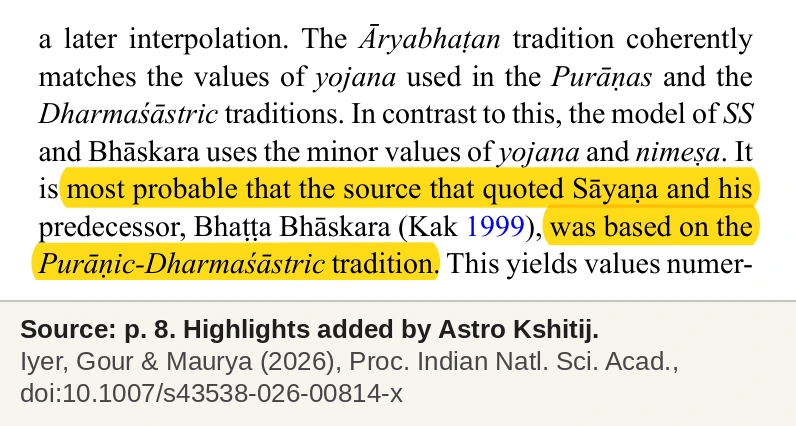
Figure 7: The paper names the Puranic and Dharmashastric tradition as the most probable basis for the line. (Iyer, Gour & Maurya 2026, p. 8)
The Vishnu Purana, which supplies one of the paper's main nimesa values, places the Sun just 100,000 yojanas from Earth, and the Moon a further 100,000 yojanas beyond the Sun.
With the Vishnu Purana's own nimesa (0.2133 s):
100,000 ÷ 4,404 × 0.2133 s = 4.8 seconds.
Put the paper's own Puranic yojanas (12.3 to 15.23 km) on that distance, and the Sun is only 1.2 to 1.5 million km away. The Sun itself is about 1.4 million km across. The real distance is about 150 million km, more than 100 times farther. And the Moon is placed farther away than the Sun.
What the sky says
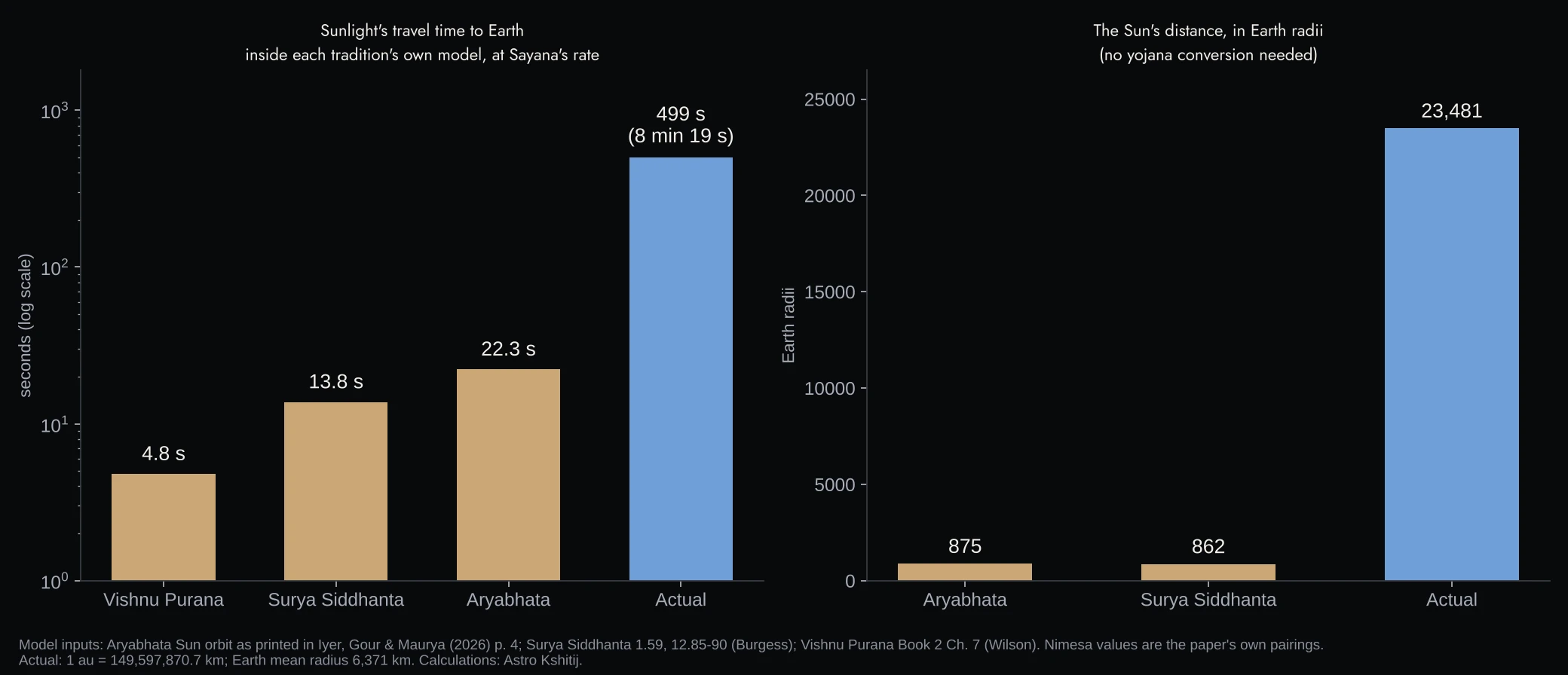
Figure 8: Sunlight's travel time and the Sun's distance, in each tradition's own numbers, against reality. (Calculations: Astro Kshitij)
| Tradition | Sun's distance in the text | Nimesa (paper's pairing) | Sunlight arrives in | Speed if the yojana is set by the Sun |
|---|---|---|---|---|
| Aryabhata | 459,585 yojanas | 0.2133 s | 22.3 s | about 22 × c |
| Surya Siddhanta | 689,378 yojanas | 0.088 s | 13.8 s | about 36 × c |
| Vishnu Purana | 100,000 yojanas | 0.2133 s | 4.8 s | about 100 × c |
| Reality | 149.6 million km | 499 s | c |
The last column is the same test seen from the other side. Instead of setting the yojana using Earth's size, set it using the Sun's distance in the same text, so that the text's Sun lands at its real distance. Do that, and Sayana's line no longer gives the speed of light. It gives 22 to 100 times the speed of light.
So here is the whole claim in two sentences. Set the yojana using Earth, the one thing these astronomers measured well, and the line looks like the speed of light. Set it using the Sun, the very body the line is addressed to, and the match is destroyed by a factor of 22 to 100.
A real physical constant doesn't care which landmark you use to set your ruler. This number does. The match isn't coming from the astronomy. It's coming from the choice of conversion.
Test 5: Could it have been measured?
The paper disclaims a measurement, but the popular claim usually implies one. So let's check whether one was even possible.
In one nimesa, light travels about 64,000 km, more than one and a half times around the Earth. So there's no way to time light over any distance on Earth using units like these. The only pre-modern route is astronomical. That's how Ole Rømer first estimated it in 1676, by timing the eclipses of Jupiter's moon Io, and his method works only if you know the size of Earth's orbit.
These astronomies placed the Sun 27 to over 100 times too close. Any astronomical measurement built on that scale would have come out wrong by the same factor. For a measured value to land within 6% of c, that error would have had to vanish. Measurement is the hardest explanation of all to defend.
Test 6: What if it's just the Sun's own speed?
The line literally addresses the Sun: you traverse 2,202 yojanas in half a nimesa. Could it simply describe the Sun's motion? The paper notes that this reading isn't supported by the astronomical texts.
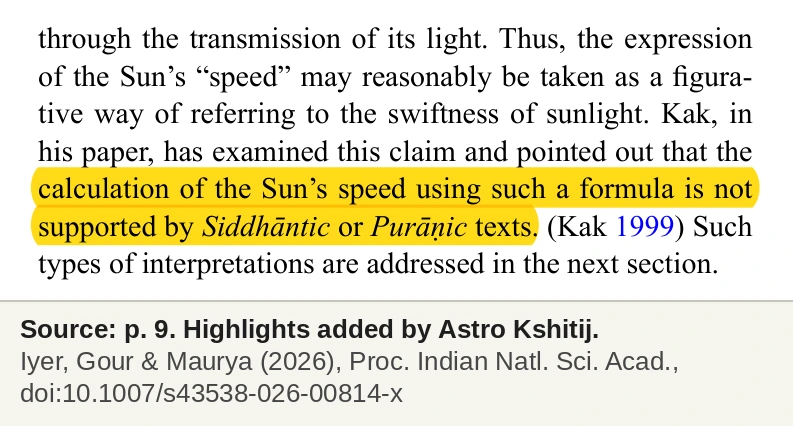
Figure 9: (Iyer, Gour & Maurya 2026, p. 9)
The numbers agree. In Aryabhata's model, the Sun moves along its orbit about 7,906 yojanas per day. Sayana's rate, with the Vishnu Purana's 405,000 nimesas per day, is about 1.78 billion yojanas per day: more than 200,000 times faster. Even the Sun's apparent daily trip around the whole sky, 2.89 million yojanas, is more than 600 times too slow.
So the number doesn't describe the Sun's motion in these models. And treated as light, it contradicts the Sun's distance in every tradition the paper draws on.
The Unit Choices Behind the Match
The pressure test shows the match depends on the choice of conversion. So how well supported are the conversions the paper actually uses? For each, here's what the paper says, what I checked, what it shows, and what it doesn't.
1. Two Arthashastra yojanas, two very different answers
What the paper says. Table 1 lists two yojana values connected to the Arthashastra, an ancient text on statecraft. One is 12.3 km, labelled "Arthashastra". The other is 15.23 km, labelled "Archaeological Studies (Dholavira)". Table 4's Arthashastra row uses 15.23 km.
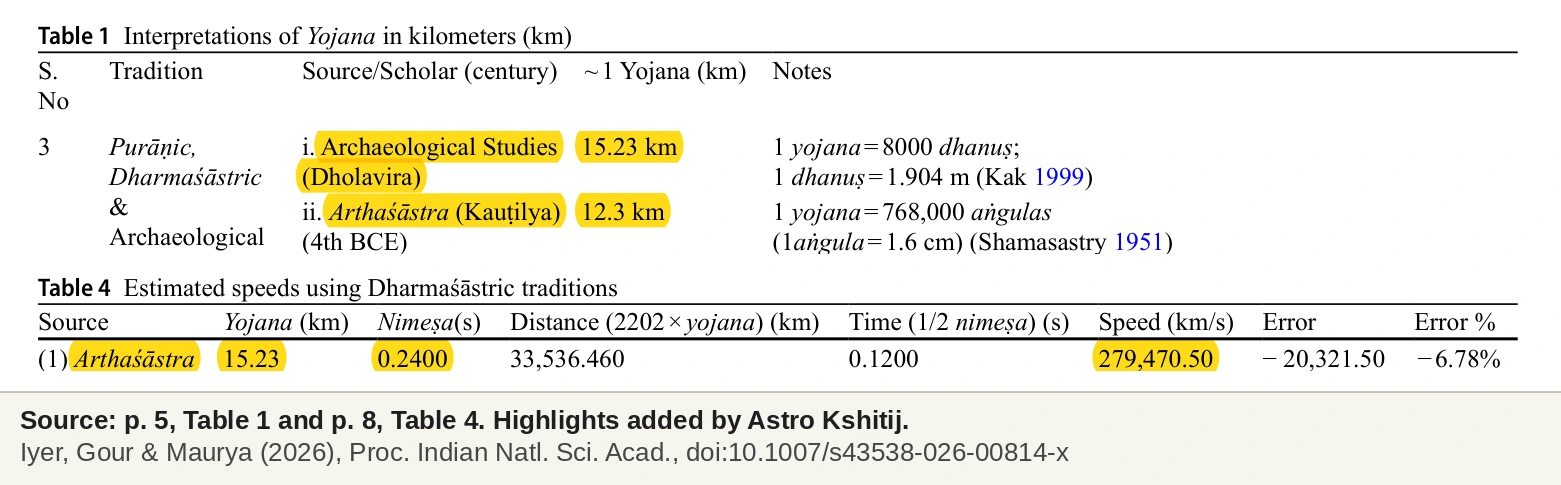
Figure 10: Two values in Table 1, and the one used in Table 4. (Iyer, Gour & Maurya 2026, p. 5, Table 1 and p. 8, Table 4)
What I checked. On page 4, the paper says a yojana is 8,000 dhanus, that a dhanus is 108 angulas, and then that a yojana is 768,000 angulas.
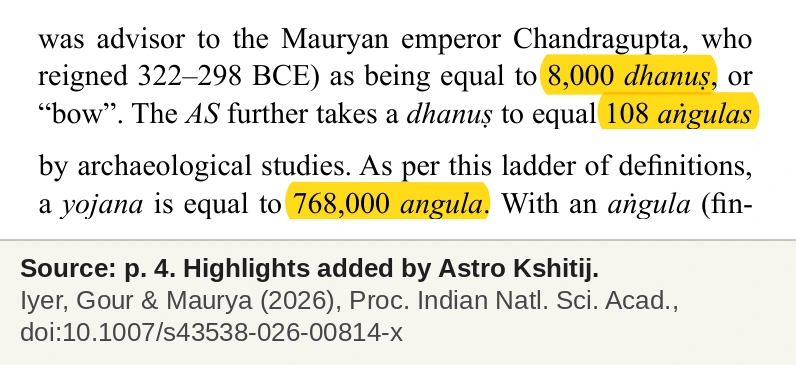
Figure 11: (Iyer, Gour & Maurya 2026, p. 4)
Those numbers don't fit. 8,000 × 108 = 864,000, not 768,000. The 768,000 works out to 96 angulas per dhanus, which matches the ordinary dhanus of the Arthashastra in Shamasastry's translation. There, the 108-angula dhanus is a separate measure used for roads and fort walls. So the paper mixes two different dhanus in one passage. Combined with its two angula sizes (1.763 cm and 1.6 cm), this reconstructs both rounded values.
Using the Arthashastra's own time unit of 0.24 s:
| Yojana in the paper | Reconstructed recipe | Speed | Difference from c |
|---|---|---|---|
| 15.23 km (used in Table 4) | 8,000 × 108 angulas of 1.763 cm | 279,470.5 km/s | about −6.8% |
| 12.3 km (labelled Arthashastra in Table 1) | 8,000 × 96 angulas of 1.6 cm | 225,705 km/s | about −24.7% |
The first row is the paper's published result. The second is my check of the value the paper itself labels Arthashastra. It is not among the paper's 16 tabulated speeds.
What it shows. One choice of units decides whether this row looks close to the speed of light or not. The paper needs to explain why the 108-angula archaeological value is the right one for Sayana's line.
What it doesn't show. The archaeological reading may have support, and the paper gives a reason for it on page 4. This doesn't show intent: the paper publishes results far above c and rejects an earlier, closer calculation (p. 10). But a better match can't, by itself, show a choice was historically correct.
2. Where the closest row's yojana comes from
What the paper says. The 12.87 km yojana in the closest row is credited to Ganganath Jha, writing on Manu 8.406, who equates one yojana with 8 miles.
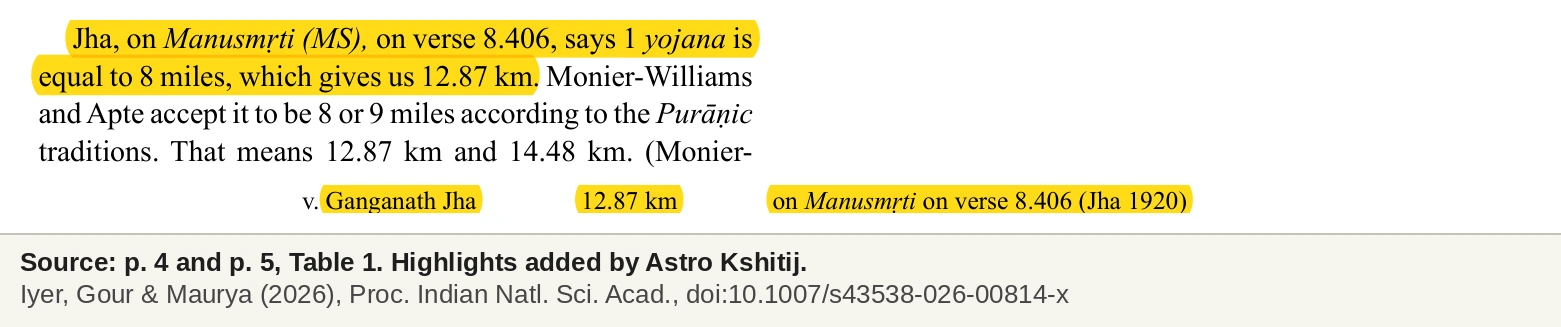
Figure 12: The source of the 12.87 km yojana. (Iyer, Gour & Maurya 2026, p. 4 and p. 5, Table 1)
What I checked. Manu 8.406 is about boat fares on long river journeys. In Jha's English rendering of the commentary, "one Yojana (8 miles)" appears as a parenthetical English gloss. The Sanskrit commentary at that point talks about one and two yojanas, but gives no conversion into miles or any other unit.
What it shows. The closest result in the paper rests on an English gloss. The cited passage, on its own, doesn't establish an ancient length unit, paired with an ancient time unit, that applies to Sayana's statement.
What it doesn't show. I'm not saying the 8-mile figure is wrong or unsupported elsewhere, and this says nothing against Manu's time units. The question is what else supports this conversion, and why it applies to Sayana's line.
3. An Earth size that doesn't match its cited source
What the paper says. For the Surya Siddhanta, the paper takes Earth's circumference as 4,800 yojanas, citing Burgess's English translation. From this it gets about 8.35 km per yojana.
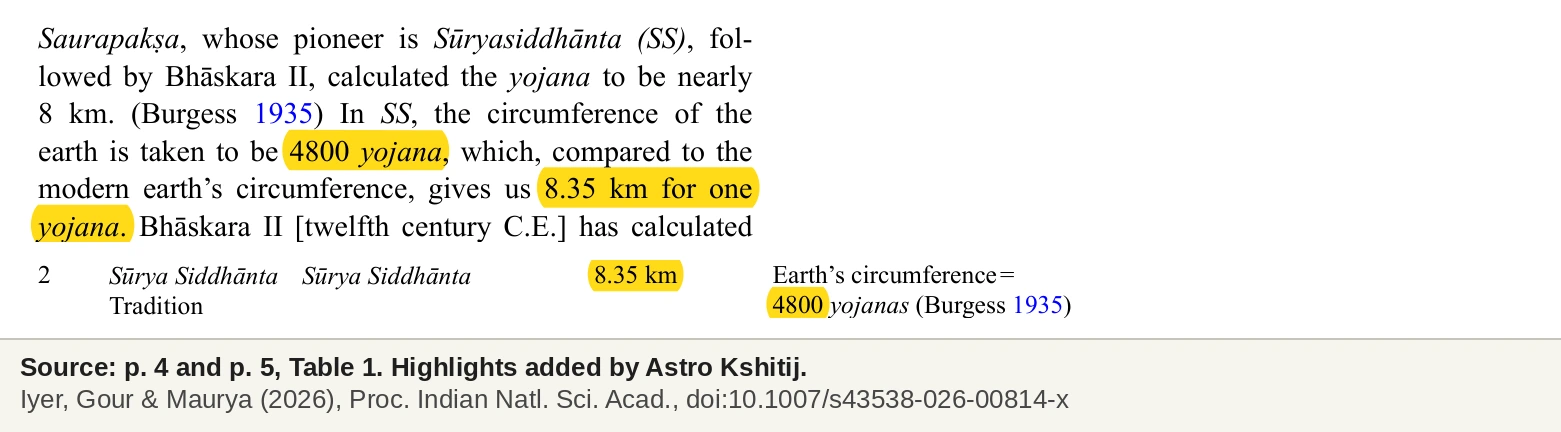
Figure 13: (Iyer, Gour & Maurya 2026, p. 4 and p. 5, Table 1)
What I checked. In Burgess's translation, verse I.59 (printed page 43) gives Earth's diameter as 1,600 yojanas, with a circumference rule of the square root of ten times the diameter squared: 1,600 × √10 ≈ 5,059.64 yojanas, not 4,800. Burgess's next page gives 5,059.556. Venugopal and colleagues, cited by the paper itself, use this Burgess figure, and note that 4,800 appears in other works (2019, printed p. 403).
What it shows. The number used doesn't match the cited source, and it's the starting point of that calibration.
What it doesn't show. 4,800 is genuinely used in related traditions, so it wasn't made up. Using about 5,060 would actually move that row a little closer to c, though it would stay above.
4. Does a bigger unit make a better fit?
What the paper says. The paper sets aside the smaller yojana values as local units, saying astronomy needs "larger and more consistent units".
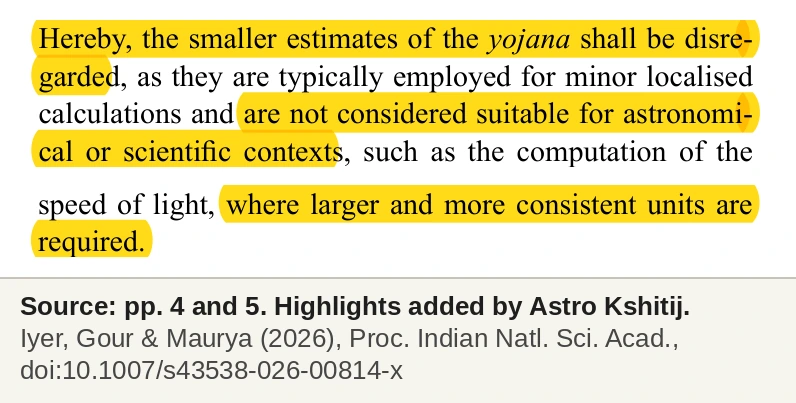
Figure 14: (Iyer, Gour & Maurya 2026, pp. 4 and 5)
What it shows. Physics doesn't need a large unit to describe a large speed. The speed of light is the same in kilometres or millimetres per second. So the size of a unit, and its supposed suitability for astronomy, can't by themselves establish which yojana Sayana's quotation means.
What it doesn't show. A real local-versus-astronomical distinction could exist. It needs historical evidence about this quotation, not the size of the unit.
Smaller Errors
These don't decide the question, but they should be corrected:
- Two wrong entries in the paper's Table 2. Dividing the paper's sidereal day (86,164.0905 s, the time Earth takes to spin once relative to the stars) by 486,000 gives 0.17729 s, not the printed 0.17740 s. Dividing it by 202,500 gives 0.42550 s, not 0.42584 s. Neither feeds the 16 speeds. All seven entries are checked in the appendix.
- The 0.088 s nimesa. The paper's text gives about 0.0886 s and its Table 2 gives 0.08865 s and 0.08889 s, all of which round to 0.089. Table 5 uses 0.088 (p. 6).
- Which modern Earth? The calibration uses a radius of "approximately 6,437 km". NASA gives 6,371 km (mean) and 6,378.137 km (equatorial). Different parts of the paper also imply different Earth sizes: Table 1's Nilakantha and Yallaya values imply about 6,439 km, while the same scholars' values in the prose on page 3 imply about 6,376 km.
- "Within a 33% margin" (p. 9) describes a pair the paper's own Table 5 puts at +34.7%, and credits it to Brahmagupta, while Tables 1 and 5 credit the 8.07 km yojana to Bhaskara II.
- On page 7, the yojanas are said to range up to 15.54 km; Table 1's largest is 15.23 km. The verse is cited as Rigveda 1.50.4 on page 2 and 1.50.5 on page 9. Page 4 says "800 angulas" for the 15.232 km yojana.
How Strong Is the Argument?
Many conversions are not many measurements. The 16 speeds are 16 readings of one sentence, not 16 independent measurements of light. Several landing in the same range tells us about the units chosen, not about separate confirmations.
A specific number is not a measured number. The paper argues that 2,202 is oddly specific, as if someone was aiming for precision.
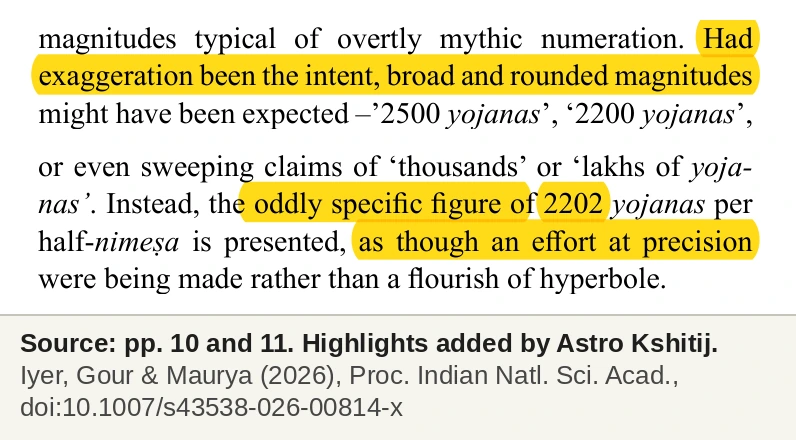
Figure 15: (Iyer, Gour & Maurya 2026, pp. 10 and 11)
But writing 2,202 rather than 2,200 doesn't tell us the method, the uncertainty, or the accuracy behind it. The paper itself offers 2,200 as an example of a rounded figure, and the difference is only about 0.09%. The pressure test shows the real uncertainty is a factor of 22 to 100.
A possible reading becomes a firm one. On page 9, the paper suggests the Sun's "speed" may be a figurative way of describing the speed of sunlight.
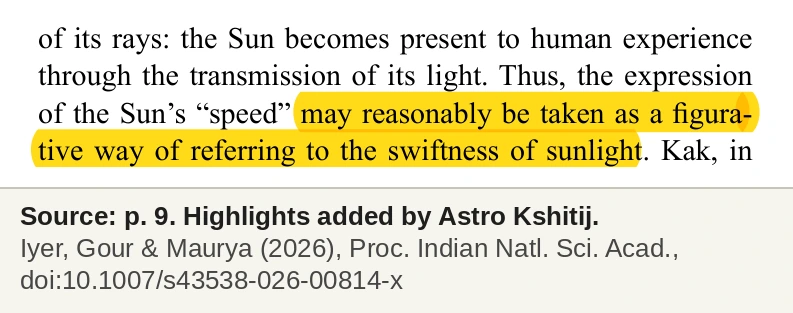
Figure 16: A possible reading, offered on page 9. (Iyer, Gour & Maurya 2026, p. 9)
By page 11, it describes Sayana as postulating a value for the speed of light.
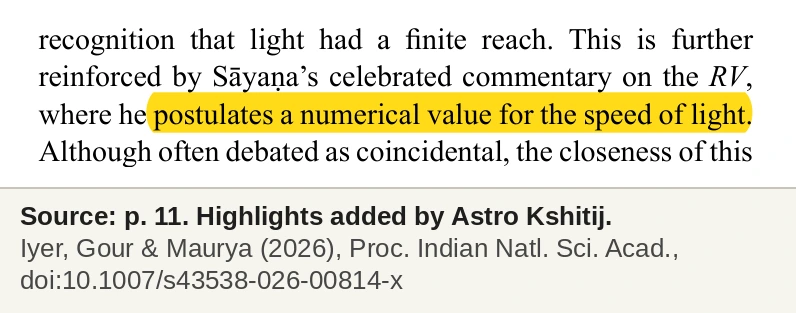
Figure 17: Firmer wording on page 11. (Iyer, Gour & Maurya 2026, p. 11)
Page 12 then disclaims an experimental determination (Figure 2). But a figurative reading can't become a postulated value without evidence, and the pressure test shows the sunlight reading clashes with the Sun's distance in every tradition the paper uses.
So, Where Does This Leave Us?
When I heard this claim from that stage at 14, it felt thrilling. Testing it properly, years later, I understand why it's so convincing, and why it doesn't hold.
The paper's 16 divisions are correct, and with the right units the line really does land within about 6% of the speed of light. That's the part people share.
Here's the part they don't. That match only exists when the yojana is set using Earth's size, the one quantity these astronomers measured well. Run the same line through the rest of their own sky, and it breaks. Inside their own models, sunlight would reach us in 5 to 22 seconds. Set the yojana using the Sun instead, and the line gives 22 to 100 times the speed of light. A number that only works when you choose its ruler carefully is not a hidden physical constant. It's a coincidence of conversion.
On top of that, the conversions themselves are thin. The closest result rests on an English gloss. One Arthashastra row swings from about 7% to about 25% off depending on which of the paper's own values you use. And a key Earth size doesn't match its cited source.
None of this takes anything away from ancient Indian astronomy, which has real achievements worth celebrating with evidence. It just means this particular claim isn't one of them. The paper itself stops short of claiming a measurement. The popular version of this claim should stop there too.
If you spot a mistake in my working, I genuinely want to hear about it. You can write to me here.
Check It Yourself
Everything below works on an ordinary calculator.
Speed from any row: 4404 × Y ÷ N. Use the full nimesa, because the 4,404 already includes the "half".
Percentage difference: 100 × (speed ÷ 299792.458 − 1). Positive means above the speed of light, negative means below.
Sunlight travel time in a tradition's own units: (D ÷ 4404) × N seconds, where D is the Sun's distance in yojanas. For an orbit given as a circumference C, D = C ÷ (2 × π).
- Aryabhata:
2887666.8 ÷ (2 × π) ÷ 4404 × 0.2133 ≈ 22.3s - Surya Siddhanta:
4331500 ÷ (2 × π) ÷ 4404 × 0.088 ≈ 13.8s - Vishnu Purana:
100000 ÷ 4404 × 0.2133 ≈ 4.8s - Reality:
149597870.7 ÷ 299792.458 ≈ 499s
Speed if the yojana is set by the Sun: 499 ÷ (light time above), as a multiple of c. For Aryabhata, 499 ÷ 22.3 ≈ 22.
Sun's distance in Earth radii: (C ÷ (2 × π)) ÷ (Earth diameter in yojanas ÷ 2). Aryabhata: 459585 ÷ 525 ≈ 875. Surya Siddhanta: 689378 ÷ 800 ≈ 862. Reality: 149597870.7 ÷ 6371 ≈ 23481.
The Surya Siddhanta Sun orbit, from its own rules: the Moon's orbit of 324,000 yojanas, times the Moon's 57,753,336 revolutions, divided by the Sun's 4,320,000 revolutions per great age: 324000 × 57753336 ÷ 4320000 ≈ 4331500.
The closest row: 4404 × 12.87 ÷ 0.1778 = 318,782.227 km/s, about +6.334%.
The two Arthashastra yojanas: 4404 × 15.23 ÷ 0.24 = 279,470.5 km/s (about −6.78%), and 4404 × 12.3 ÷ 0.24 = 225,705 km/s (about −24.71%).
The Surya Siddhanta circumference: 1600 × √10 ≈ 5059.64 yojanas (the paper uses 4,800).
Appendix: All 16 Tabulated Speeds
These use the paper's printed inputs exactly. All 16 speeds match the paper to the displayed rounding. The percentages also match, except that the paper prints −15.44% for the second row, where standard rounding gives −15.45%.
| Yojana source | Nimesa source | Speed (km/s) | Difference from c |
|---|---|---|---|
| Nilakantha (12.26 km) | Vishnu Purana (0.2133 s) | 253,131.927 | −15.564% |
| Nilakantha (12.26 km) | Mahabharata (0.2130 s) | 253,488.451 | −15.445% |
| Aryabhata (12.13 km) | Vishnu Purana (0.2133 s) | 250,447.820 | −16.460% |
| Aryabhata (12.13 km) | Mahabharata (0.2130 s) | 250,800.563 | −16.342% |
| Yallaya (12.29 km) | Vishnu Purana (0.2133 s) | 253,751.336 | −15.358% |
| Yallaya (12.29 km) | Mahabharata (0.2130 s) | 254,108.732 | −15.238% |
| Matsya Purana (12.30 km) | Vishnu Purana (0.2133 s) | 253,957.806 | −15.289% |
| Matsya Purana (12.30 km) | Mahabharata (0.2130 s) | 254,315.493 | −15.169% |
| Brahmanda Purana (13.54 km) | Vishnu Purana (0.2133 s) | 279,560.056 | −6.749% |
| Brahmanda Purana (13.54 km) | Mahabharata (0.2130 s) | 279,953.803 | −6.617% |
| Varahamihira (12.523 km) | Vishnu Purana (0.2133 s) | 258,562.082 | −13.753% |
| Varahamihira (12.523 km) | Mahabharata (0.2130 s) | 258,926.254 | −13.631% |
| Arthashastra (15.23 km) | Arthashastra (0.24 s) | 279,470.500 | −6.779% |
| Manusmriti (12.87 km) | Manusmriti (0.1778 s) | 318,782.227 | +6.334% |
| Bhaskara II (8.07 km) | 0.088 s | 403,866.818 | +34.715% |
| Surya Siddhanta (8.35 km) | 0.088 s | 417,879.545 | +39.390% |
Appendix: All Seven Entries in the Paper's Table 2
Each row multiplies out the paper's own unit hierarchy to get nimesas per day, then divides the ordinary day (86,400 s) and the sidereal day (86,164.0905 s) by that number.
| Text | Hierarchy multiplied out | Nimesas per day | Ordinary day: correct / printed | Sidereal day: correct / printed | Verdict |
|---|---|---|---|---|---|
| Siddhanta Shiromani | 18 × 30 × 30 × 2 × 30 | 972,000 | 0.08889 / 0.08889 | 0.08865 / 0.08865 | Matches |
| Manusmriti | 18 × 30 × 30 × 30 | 486,000 | 0.17778 / 0.17778 | 0.17729 / 0.17740 | Sidereal entry wrong |
| Vishnu Purana | 15 × 30 × 30 × 30 | 405,000 | 0.21333 / 0.21333 | 0.21275 / 0.21275 | Matches |
| Mahabharata | 15 × 30 × 30.1 × 30 | 406,350 | 0.21262 / 0.213 | 0.21204 / 0.2127 | Printed values follow the approximate "~405,000" shown, not the stated hierarchy |
| Arthashastra | 5 × 30 × 40 × 2 × 30 | 360,000 | 0.24 / 0.24 | 0.23934 / 0.239 | Matches |
| Bhagavata Purana | 3 × 5 × 15 × 15 × 2 × 30 | 202,500 | 0.42667 / 0.42667 | 0.42550 / 0.42584 | Sidereal entry wrong |
| Sridhara's commentary | 15 × 30 × 30 × 2 × 30 | 810,000 | 0.10667 / 0.1067 | 0.10638 / 0.1064 | Matches |
The Mahabharata row is an approximation rather than a clear mistake. Its hierarchy includes 30 and one-tenth kalas per muhurta, which gives 406,350, and the paper marks its 405,000 with "~". The difference is about 0.3%.
Sources
- Iyer, K., Gour, M. and Maurya, G. (2026). Pre-Rømer reflections on the speed of light in Indian texts: a scientific and philological reassessment of Sāyaṇa's Ṛgveda commentary. Proceedings of the Indian National Science Academy, published 3 August 2026. doi.org/10.1007/s43538-026-00814-x. All highlighted figures are from this paper; highlights added.
- Burgess, E. (trans.) (1935). Translation of the Sūrya Siddhānta. University of Calcutta. Verse I.59, printed pp. 43 to 44; verses XII.85 to 90. PDF
- Wilson, H. H. (trans.) (1840). The Vishnu Purana, Book 2, Chapter 7. Online text
- Shamasastry, R. (trans.). Kautilya's Arthashastra, Book 2, Chapter 20, on the ordinary and garhapatya dhanus. Online text
- Venugopal, P., Rupa, K., Uma, S. K. and Rao, S. B. (2019). The concepts of deśāntara and yojana in Indian astronomy. Journal of Astronomical History and Heritage, 22(3), 401 to 406, printed p. 403. PDF
- Jha, G. (trans.). Manusmṛti with the commentary of Medhātithi, verse 8.406. English rendering and Sanskrit commentary.
- NASA. Earth Fact Sheet.
- International Astronomical Union (2012). Resolution B2, defining the astronomical unit as 149,597,870,700 m.